What if the difference between your most senior technician and a new hire wasn’t the years of experience, but the intelligence of the system guiding them?
In the enterprise, “Time-to-Competency” is a financial drain. Every day a new hire spends “shadowing” is a day they aren’t generating revenue—and a day your veteran technician is working at 50% capacity, splitting their focus between the task and their pupil. Traditionally, we’ve accepted that it takes years to build a “veteran.” We’ve treated expertise like a slow-growing tree, something that can’t be rushed.
But in a world of rapid retirements, a shrinking labor pool, and increasing asset complexity, the enterprise no longer has the luxury of time.
At GIDR.ai, we don’t believe it takes years to build a veteran. It takes the right System of Execution. The goal is not to force a new hire to memorize 30 years of experience, but to provide them with that experience at the exact moment of intervention.
Here is our Tactical Roadmap for accelerating a new hire from Day 0 to Day 30 autonomous performance.
The Tactical 30-Day Roadmap: From Rookie to Reliable
This roadmap requires a fundamental shift in onboarding. You are no longer training for memory (what to do); you are training for execution (how to use the system that guides you).
Phase 1: Days 1–7 | The Safety “Hard-Stop”
- Objective: Total Elimination of Catastrophic Risk.
In the first week, a new hire’s most important job is not fixing the asset—it’s staying safe. Traditional onboarding relies on the new hire remembering the safety slides they saw in a classroom. GIDR.ai replaces memory with a digital supervisor that cannot be ignored.
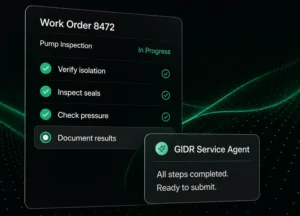
- Tactical Implementation: Deploy Safety “Hard-Stops.” The AI disables the “Next Step” button on the technician’s device until a high-risk safety verification is met.
- Example: The technician must upload a photo of a locked-out power source. The GIDR AI validates the image in real-time, confirming the lock is present before allowing the workflow to proceed.
- The Result: You remove “rookie mistakes” from the equation. The new hire is 100% safe on the job site from Day 1, without requiring a senior technician to hover.
Phase 2: Days 8–21 | Contextual Intelligence & Tribal Knowledge
- Objective: Moving from “What” to “How.”
This is where the “Experience Debt”—the gap between required skill and actual skill—is paid. Instead of a new hire stopping to flip through a 100-page manual or guessing how to handle a legacy asset, GIDR.ai surfaces the “Expert Tip” at the moment it’s needed.
- Tactical Implementation: Use In-Line Micro-Guidance. As the technician follows the procedure, GIDR.ai uses multimodal agents (voice/image/video) to push contextual “veteran tips” captured from your best operators.
- Example: When the technician reaches a specific high-pressure valve, GIDR.ai plays a 15-second audio clip: “This specific valve often seats tight. Use the specialized wrench, and torque it to 45 foot-pounds, not 30 as listed in the older manual.”
- The Result: The new hire executes with the “intuition” of a 30-year veteran because the system is feeding them that intuition in real-time. They aren’t just following a checklist; they are inheriting a legacy of expertise.
Phase 3: Days 22–30 | Autonomous Validation
- Objective: Shift from Guidance to Verification.
By the final week, the “training wheels” begin to retract, but the safety net remains absolute. The system moves from telling them how to do it to verifying that they have performed it correctly.
- Tactical Implementation: Activate Automated Quality Assurance (AQA). The technician performs the task autonomously, but GIDR.ai’s “digital thread” captures every action, voice command, and image.
- Example: Upon completion, the AI runs a final multi-modal check. If it detects that a seal was not properly applied (via a post-work image check) or that the proper torque was not validated (via data integration), it flags the error for immediate correction before the job is closed.
- The Result: By Day 30, the new hire is closing work orders with the same accuracy and compliance rate as your top 10% of technicians. You haven’t just trained them; you have validated their performance.
Conclusion: Stop Waiting for Experts. Build Them.
The math is simple: traditional onboarding takes ~180 days to value. The GIDR.ai System of Execution reduces that to 30 Days.
Shadowing is not a strategy; it’s a bottleneck. If your organization’s growth is capped by how fast you can “train” people, you are ceding market share to the competition.
Closing the Service Execution Gap means building the expertise into the system itself. When you do that, you don’t just onboard faster—you scale excellence. You don’t need 30 years to build a veteran. You just need a System of Execution.