In the corporate boardroom, the plan is always perfect.
Enterprises spend millions of dollars and thousands of hours on “Digital Transformation.” They hire top-tier consultants to map out “Future State” workflows. They purchase the most expensive CRMs and ERPs to act as their Systems of Record. On paper, the operation is a masterpiece of efficiency, safety, and compliance.
Then, the plan hits the frontline.
In the field, on the factory floor, or inside a high-voltage substation, that “perfect plan” often dissolves. Instead of following the digital workflow, technicians rely on 50-page PDFs tucked in a truck cabin, a series of disconnected checklists, or—most commonly—”tribal knowledge” passed down through unwritten rules.
This is the Service Execution Gap. It is the invisible space between strategic intent and operational reality. And for most enterprises, it is where their biggest risks live.
The Failure of the “System of Record”
For the last two decades, the enterprise tech stack has been dominated by Systems of Record. These platforms (think Salesforce, SAP, or ServiceNow) are excellent at telling you what happened. They can tell you that a job was opened, that a part was ordered, and that a technician clocked out.
But they are notoriously bad at ensuring how the work was actually performed.
A System of Record is a rearview mirror. It captures data after the fact. It doesn’t stop a technician from skipping a critical safety step in the moment. It doesn’t prevent a compliance error before it’s recorded. It simply documents the outcome—whether that outcome was a success or a liability.
Why Variability is the Silent Killer
When you have a Service Execution Gap, you have variability. And in high-stakes industries—like energy, manufacturing, and telecommunications—variability is the enemy of excellence.
When execution varies from person to person or site to site:
- Safety risks increase: Procedures are improvised rather than followed.
- Compliance erodes: Regulatory standards become “suggestions” in the heat of a busy shift.
- Costs skyrocket: Rework, “truck rolls,” and warranty claims become a standard cost of doing business.
Introducing the System of Execution
At GIDR.ai, we believe the enterprise doesn’t need another digital filing cabinet for manuals. It needs a System of Execution.
A System of Execution isn’t about documentation; it’s about Guidance.
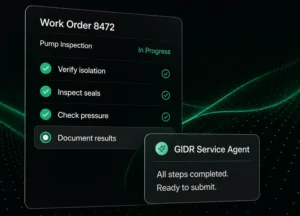
By using AI-driven guardrails, we provide real-time, context-aware instructions at the point of work. We bridge the gap by making “the right way” the only way to move forward. If a safety check isn’t verified, the next step doesn’t unlock. If a compliance photo isn’t captured, the job doesn’t close.
We are moving the enterprise from a culture of “hopeful execution” to a culture of “guaranteed performance.”
The Bottom Line
Strategy is a commodity; execution is a competitive advantage. Closing the Service Execution Gap isn’t just an operational improvement—it’s a fundamental de-risking of your entire brand.
It’s time to stop looking in the rearview mirror and start guiding the frontline. It’s time for a System of Execution.